Nutrition & Balance
The Architecture of a Balanced Plate: Notes from a Week of Seasonal Eating
Eleanor Whitfield
·

Thirty days of logged meals in a two-person London household produced something unexpected: not a comprehensive nutritional account, but a detailed map of eating habits — the patterns, the gaps, the seasonal influences, and the quiet pressures of time that shaped every meal recorded between the first of February and the second of March.
The food journal used for this observation was a standard A5 notebook — not a digital application, not a calorie-counting platform, and not a structured template. Each page held one day. Each entry was written by hand, in ordinary language, describing what was eaten without attempting to quantify it precisely. Breakfast, a mid-morning snack if one occurred, lunch, any afternoon eating, and dinner. Occasionally a note about time of day, mood, or how much of the meal was actually finished.
The choice of analogue format was deliberate. Digital nutrition applications tend to convert meals into numbers before the act of recording is complete — a calorie total appears, a macronutrient bar fills, and the user's attention shifts from what they ate to whether their numbers are within range. The analogue journal produces no such conversion. The act of writing a description of a meal in ordinary language — "roasted sweet potato, leafy greens, tahini dressing, half a flatbread" — preserves the qualitative character of the eating experience rather than reducing it immediately to data.
The trade-off is acknowledged: an analogue record produces less precise nutritional data. But for the purposes of pattern identification — the editorial aim of this observation — qualitative completeness matters more than quantitative precision. Thirty days of honest written entries reveal patterns that a month of intermittent digital logging, abandoned when the calorie count becomes discouraging, cannot.
The first week produced a surprise familiar to anyone who has conducted this exercise honestly: the meals eaten during the first seven days of keeping a food journal are not representative of the previous seven days. The act of recording changes the behaviour. Lunches became more deliberate. A Wednesday snack of biscuits at a work meeting was noted — which meant it would be noted again the following Wednesday, creating a mild but real disincentive to repeat it without awareness.
This observer-effect in food journalling is well-documented and should not be treated as a methodological flaw. It is, in fact, the primary mechanism by which a food journal functions as a wellness tool. Mindful eating is not a passive state of awareness — it is an active practice of attention, and the journal sustains that attention across a period long enough to surface genuine patterns rather than daily variation.
By day seven, the initial heightened deliberateness had softened. Meals on the weekend were recorded with less care — fewer details, broader descriptions, one entry that said simply "something with pasta, salad" without further specification. This loosening of discipline at the weekend is itself a pattern worth noting: it suggests that for many households, the careful nutritional attention of weekday eating gives way to less structured weekend habits, a gap that a food journal makes visible but does not, by itself, close.

London, February 2026 — Week Two journal, archived 14 February
By day fifteen, two recurring gaps had become visible in the log. The first was the absence of oily fish in the weekly record. In four weeks of eating, smoked salmon on two occasions and a single tin of sardines represented the total oily fish consumption. Published guidelines from the NHS and British Nutrition Foundation recommend two portions of fish per week, at least one of which should be oily. The journal confirmed a shortfall that would not have been visible without the record.
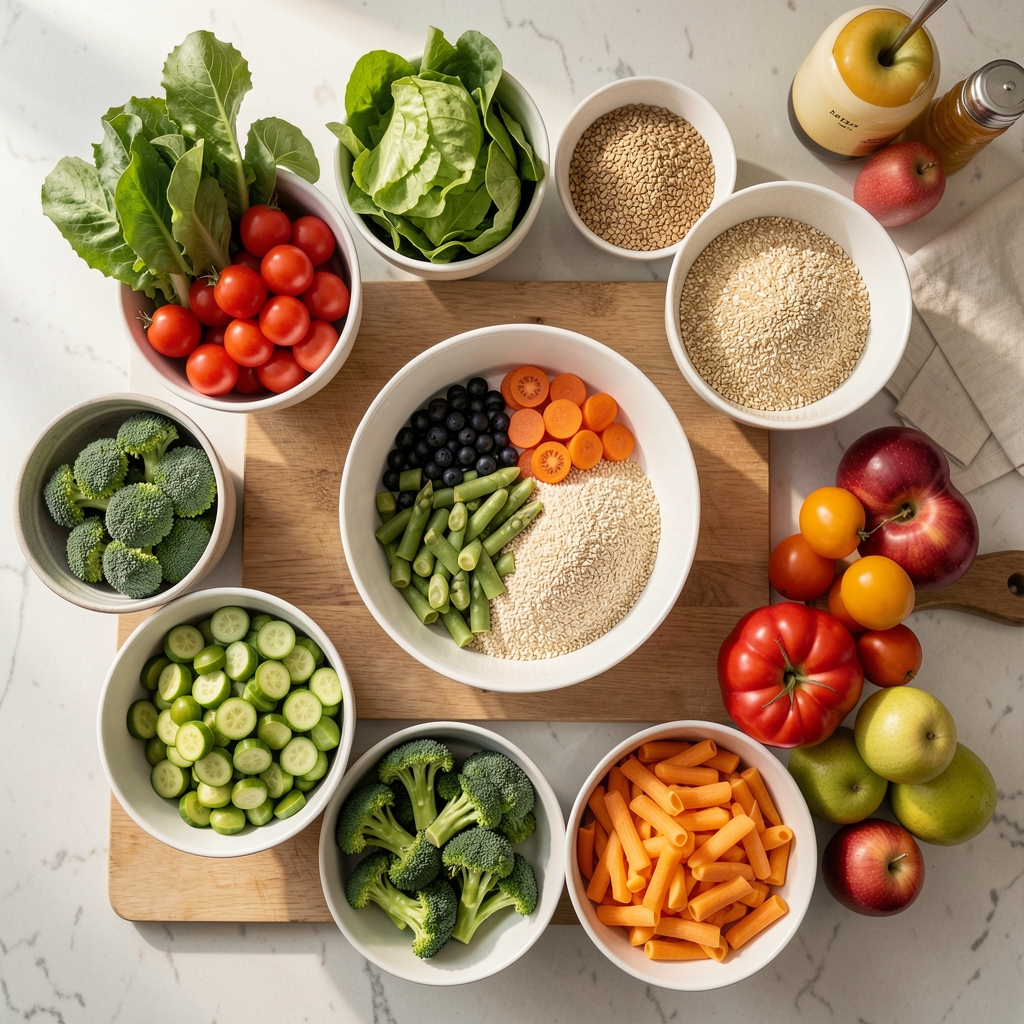
The second recurring gap was a more surprising one: fresh fruit. The household prepared fresh vegetables consistently and with variety. Leafy greens appeared in some form at nearly every dinner. Seasonal produce — parsnips, celeriac, leeks, purple sprouting broccoli — featured regularly. But fresh fruit outside of a banana at breakfast and occasional berries was largely absent. The household was not lacking in vegetables and fruits in aggregate, but the fruit side of that pairing was notably thin.
This asymmetry between vegetable and fruit consumption is, it turns out, common. A qualified nutrition professional consulted by the editorial team noted that households with strong vegetable habits frequently underweight fruit, partly because fruit requires no cooking and sits outside the meal-construction mindset, and partly because fresh fruit spoils faster than most vegetables and is easy to overlook in the grocery planning routine. The food journal made the gap visible; understanding why it existed required the additional context.
"The journal does not close the gap — it makes the gap impossible to ignore. That, it turns out, is sufficient."
February and early March in London represent the tail end of winter produce. The food journal captured the transition: by the final week of the observation, the first purple sprouting broccoli of early spring had appeared at the local greengrocer, joined by early-season spinach and the first forced rhubarb of the year. The plate's character shifted noticeably — lighter preparations, shorter cooking times, a return to raw salad elements that winter root vegetables had temporarily displaced.
The seasonal cooking dimension of a food journal is underappreciated in nutritional guidance, which tends to present dietary advice in seasonally neutral terms. Thirty days of handwritten entries captured the genuine texture of eating seasonally in a northern European city: the constraint and depth of winter, the tentative brightness of early spring, and the way these shifts happen gradually rather than on a calendar boundary.
Grocery planning improved across the month. By week three, the household had developed a loose weekly menu — not a rigid schedule, but a set of three or four prepared answers to "what shall we cook tonight?" that meant the question was no longer decided at 18:30 in front of an open refrigerator. Meal planning of this modest, approximate kind proved sufficient to reduce last-minute convenience food substitutions and maintain the week's nutritional coherence without the overhead of a formal meal plan.
At the close of the observation, the journal contained a nutritional record that was imprecise, occasionally illegible, and genuinely useful. The gaps identified — oily fish, fresh fruit, the weekend loosening — were all actionable without requiring dramatic changes to shopping habits or cooking routines. Each required a single adjustment: one additional grocery item, one planned weekend meal.
The act of keeping the journal had, by week three, become a natural part of the evening kitchen routine — a few sentences written while waiting for water to boil, or while the table was being cleared. The barrier that many people anticipate — finding time to record meals — had not materialised as a practical obstacle. What had materialised, instead, was a sustained awareness of eating as a set of daily decisions with visible cumulative consequences, rather than a sequence of individual unconnected events.
This is the most accurate description of what a food journal provides: not a nutritional database, not a weight management instrument in isolation, but a record that makes the invisible visible. The patterns it surfaces are the ones that matter for calorie awareness, nutritionist guidance, and the quiet construction of a sustainable weight approach — because they are the patterns that were already present before the journal was opened, waiting to be seen.
London, March 2026 — Field observation, archived 28 March. Sources: British Nutrition Foundation dietary guidelines; NHS guidance on fish consumption and balanced eating.

Eleanor Whitfield is a London-based editorial writer with a background in nutritional science communication. She contributes regularly to Davenolt Gazette on topics including seasonal cooking, whole-food meal construction, and the practical application of published dietary research.
Read Eleanor's earlier piece on the balanced plate →